Strength Training Isn't Optional As You Age — It's the Whole Game
Everyone tells you to "keep your muscle" after 40. Almost no one tells you that the thing you lose fastest isn't size — it's speed. And speed is what catches you on a loose descent.
Here is the part nobody mentions at your physical. Starting around 30, you don't just lose muscle — you lose the ability to use it quickly, and that ability disappears almost twice as fast as the muscle itself.
Researchers call the muscle loss sarcopenia. The slow drift is well documented: adults lose roughly 3 to 8 percent of their muscle mass per decade after 30, and the rate accelerates after 60. That's the number that makes it into the magazine headlines.
But mass is the wrong thing to watch. When scientists separate strength (how much you can move) from power (how fast you can move it), power falls off a cliff first. Type II fibers — the fast, explosive ones — shrink and go quiet earlier and faster than the slow endurance fibers. You can lose power at two to three times the rate you lose size.
So why should a hiker care about a lab distinction between strength and power?
Catching yourself on a sketchy step-down isn't a feat of strength. It's a feat of speed. And speed is the first thing to go.
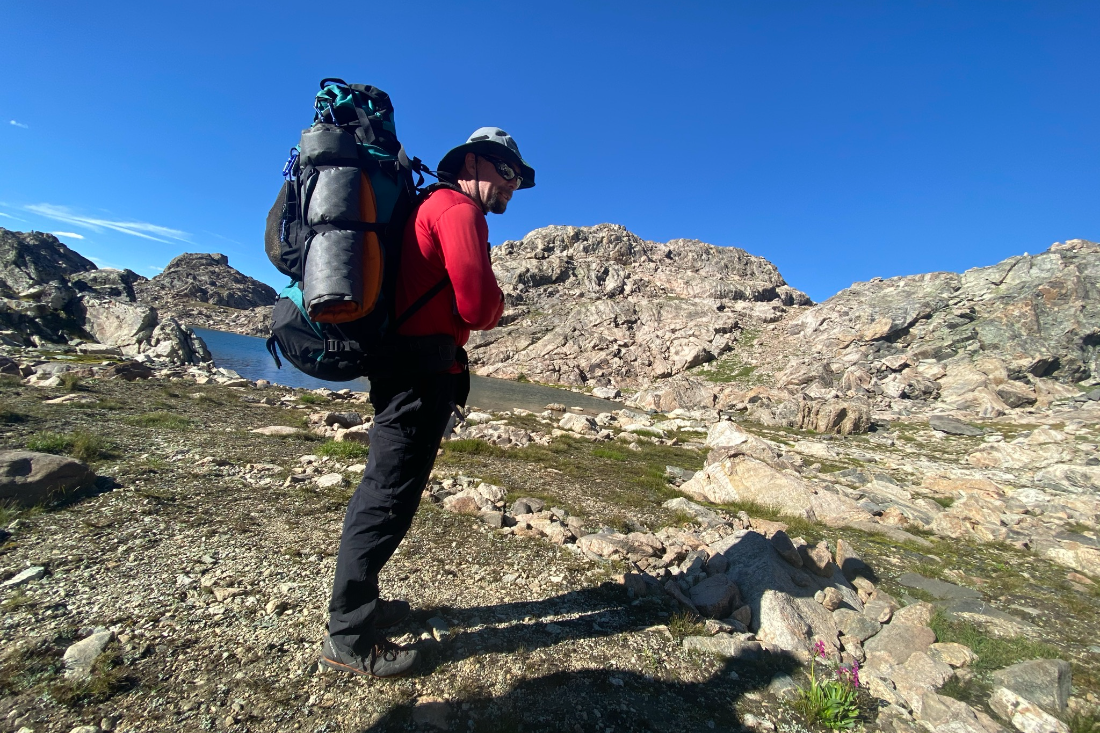
Picture the moment a rock rolls under your boot on a steep descent. Your quad doesn't have a second and a half to slowly brace. It has maybe a tenth of a second to fire hard and stabilize the knee. That's pure power — force delivered fast. Train only slow, grinding lifts and you can be "strong" on paper while the exact quality that keeps you upright quietly erodes.
The good news is almost unfair
The decline is real. It is also one of the most reversible things in all of medicine.
The landmark proof is decades old and still startling. In a 1990 study published in the Journal of the American Medical Association, frail nursing-home residents — average age 90, some pushing 96 — did eight weeks of progressive resistance training. Their strength rose by an average of roughly 174 percent. Some of them put away their canes. At ninety.
Read that again. The body never stops answering the phone. The muscle-building signal works in your 40s, your 60s, your 90s. It just needs a reason to fire — and that reason is meaningful resistance, applied consistently.
Grip strength — a simple proxy for total-body strength — is one of the cleaner predictors of all-cause mortality we have. In large cohort studies, every incremental drop in grip strength tracks with higher risk of dying from any cause, often outperforming blood pressure as a signal.
The point isn't the handshake. It's that whole-body strength is a vital sign, and unlike most vital signs, you can directly train it upward.
What this changes about how you train
If power is the first thing to fade, then the fix isn't only heavier. It's also faster. Most people over 40 have never been coached to move a moderate weight with intent — to drive out of a squat with speed instead of grinding it up in slow motion.
You don't need to become a sprinter. You need a handful of movements, trained with real intent, a couple of times a week:
- Load the big patterns. Squat, hinge, push, pull, carry. These are the movements your mountain days are built from, so these are the movements that transfer.
- Add intent, not just iron. On some sets, move a moderate weight as fast as you can control it. That's how you train the fast fibers that protect your joints when terrain surprises you.
- Train balance on purpose. Single-leg work isn't a warm-up afterthought — it's the rehearsal for every off-camber step you'll take above treeline.
- Progress something. A little more weight, one more rep, a half-inch deeper. Muscle responds to a demand it hasn't met yet, at any age.
The short version
- After 30 you lose power faster than size — and power is what saves you on technical ground.
- Resistance training reverses the decline at any age, even into the 90s.
- Whole-body strength behaves like a vital sign you can train upward.
- Train the big patterns with speed and intent, not just slow, heavy reps.
Aging takes power away on a schedule you didn't choose. Training puts it back on a schedule you do. That's the whole game — and it's far more winnable than anyone told you.
Want this built around your mountains?
I write strength programs for hikers, skiers, and adventurers of every age — in person in Park City, or remotely with video form review wherever you live.
Book a Session →Sources & further reading
Fiatarone MA, et al. "High-intensity strength training in nonagenarians." JAMA, 1990. · Cruz-Jentoft AJ, et al. "Sarcopenia: revised European consensus on definition and diagnosis." Age and Ageing, 2019. · Leong DP, et al. "Prognostic value of grip strength (PURE study)." The Lancet, 2015. · Reid KF & Fielding RA. "Skeletal muscle power: a critical determinant of physical functioning in older adults." Exercise and Sport Sciences Reviews, 2012.